Showing posts with label Religious Traditionalism. Show all posts

Sunday, May 5, 2013

Book Review: A History of Christianity, The First Three Thousand Years. Or, An Agnostic's Reason Why He Is Still Fascinated With His Religious Heritage

Blog Song for the Moment
Bach, Ein feste Burg ist unser Gott, BWV 80: Aria: Komm in mein Herzenshaus, with soprano solo by Joanne Lunn.  From Bach, J.S.: Cantatas, Vol. 20--BWV 5, 48, 56, 79, 80, 90, 192, Conductor John Eliot Gardiner (2000)

I suspect I picked up Diarmaid MacCulloch's History of Christianity not just because it was named one of the 100 notable books of 2010 by the New York Times Book Review, but because of his name.  I pictured a tonsured Scottish monk, sometime in the 9th century, scrawling away in a candle lit cell, one ear listening for marauding Vikings. He's actually a 21st century history professor at Oxford.
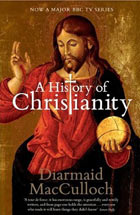
While I've read numerous histories of Christianity, particularly its US variant, this is the first one that I know of by an author with whom I share a similar religious biography (most social science and history authors obey the empiricist premise that their biographies are irrelevant to their objective work).  He has the "happiest memories" of growing up in the Anglican Church (his grandfather and father were clergymen), he "was brought up in the presence of the Bible, and [he remembers] with affection what it was like to hold a dogmatic position on the statements of Christian belief." While no longer an orthodox believer, he describes himself as a "candid friend of Christianity" with an "apophatic form of the Christian faith," which, if I understand the term, means he believes in God, but doesn't think any hard and fast claims can be made because God is beyond human ken (p. 11, paperback edition). He doesn't talk about why he is now just a "friend" and not a believer, though in a biography posted elsewhere, he apparently left the Anglican church in 1988 over its hostile position on homosexuality (MacCulloch had been a member of the "Gay Christian Movement" since 1976).

My spiritual life has followed an analogous path.  I treasure my memories of growing up in Good Shepherd Lutheran Church, where I attended kindergarten, took catechism classes and was confirmed.  The good people of Good Shepherd cushioned my adolescent travails, tolerated my foray into fundamentalism and youthful, fiery critique of Lutheranism, welcomed me back as a Sunday School teacher, musician, youth group leader, and assisting minister, and joined in celebrating my marriage.  Good Shepherd fed my love of music, shaped and sharpened my intellectual world with study of the Bible and church teachings that didn't simply fill me with dogma, but, and I'm realizing this now, encouraged me to be a critical reader and thinker.

Jesus People Expo, Dallas, TX, 1972
From http://www.one-way.org/jesusmovement/
That critical faculty, in part, explains why I left the church and my faith, though I'm not going to attribute my apostasy to it alone.  I know lots of critical thinkers who hold onto their faith.  I suppose in my case it was a matter of intellectual choices I made in in my twenties in reaction to a series of crucial experiences.  From around the age of 16 to 20 (1976-80), I was in what I now refer to as my "fundy period."  I imagine I was caught up in the last wake of the "Jesus People" movement--an evangelical Christian riff on the the Sixties' counter-culture movements--part of which would fold into the country's general lurch to the right in the Reagan years (interestingly, in 1980 I didn't vote for Ronald Reagan or Jimmy Carter, but the environmentalist Barry Commoner, a harbinger of my own impending lurch to the left). A bad experience in a scandal-ridden mega-church led me to doubt all religious authority, to doubt anyone who claimed to know "the Way." A near simultaneous break up with my first serious girlfriend no doubt contributed to my spiritual doubts--I'd thought our relationship was somehow divinely sanctioned.  An important part of a neo-evangelical teaching is learning to hear God's voice (see the anthropologist T.M. Luhrmann's fascinating investigation of this in When God Talks Back).  I thought I'd heard a thumbs-up from God on our relationship.  But I heard lots of messages that turned out to be me just talking to myself--though I'm sure veteran practitioners would say I'd given up too soon and too easily.  So when I realized I had been clueless about God's will for my life, I began to question the whole enterprise of divining providence, especially when others divined it to mean things that ran against my views--still gelling at the time--on social justice, equality, and the environment.  In other words, I was coming to believe that Christianity was too often a convenient rationale for political positions.  It was unfair of me to lump all Christians together in this perspective, and I think now it was my youthfully earnest but simplistic riposte to the equally simplistic critiques coming out of the growing religious right in the early 1980s.  Still, it's interesting that a recent sociological study by David Campbell and Robert Putnam (discussed in an earlier post) found that the number of people not affiliated with a particular church has been climbing in recent decades, and the current young generation--a third of which reported no religious affiliation in 2011--cite conservative politics as the reason for not joining.  Perhaps I was one of many canaries in the coal mine.

San Francisco La Union, Quetzaltenango, a Mayan village
in the Guatemalan western highlands.  My wife, Margo, and
I lived there as Peace Corps volunteers from 1986 to 1988.
Peace Corps sort of sealed the deal.  Three and half years in Guatemala as a volunteer (1984-88) broke the pattern of church-going and the continual contact with a faith community. 'Use it or lose it,' they say, but I should add that I didn't really have the time to miss my life in the church. In that hiatus from my relatively secure, sedate life in the States, I was the "other" for a change, and on top of doing my job as a 4-H club promoter and informal agricultural extensionist, there was a great deal of work--emotional and intellectual--in navigating Guatemala's physical, social, and cultural terrain (and I made many, many wrong turns along the way).  That experience put into relief much of what I had taken for granted as middle class male WASP from the wealthiest, most powerful country in the world (for example, my bloated notions of the virtue of punctuality, or of individualism).  And I guess I took to heart something a Peace Corps trainer said early on, something like, "when facing the differences you will inevitably face, don't think 'how weird!'  Instead, think 'equally logical, just different.'"  That's a pretty relativistic stance to take on the world, but it's one that helped me get through some tough moments when I knew I had absolutely no idea of what was going on around me, or when I felt so misunderstood.  And I saw what happened to some gringos--volunteers, US AID or Embassy staff, and ex-patriots--who could not or would not accommodate the new environment because of their universalist premise--that their world-view and way of life were and should be applicable everywhere, or were superior to those of others.  They were, at best, mystified, but more often than not they were arrogant, condescending, or just bitter.

I cannot say that I consistently avoided displaying similar features during my Peace Corps stint, but,  getting back to the point of this little bio, it was the practice of a relativist approach (hardly absolute, mind you--I'm no nihilist) that replaced my attachment to Christian doctrine, chunks of which I already tossed out by the time I reached Guatemala.  I simply could no longer believe Christianity's claims of exclusivity.  Along with that, my intellectual journey took me in a direction opposite of that I had followed in my fundy period--from looking for a dependable dogma that would clarify the world for me, I shifted to a willingness to live with murky questions and uncertain answers (Okay, another parenthetical aside, sorry. A Barna study on why young adults who were regular church-goers in their teens now no longer attend, captured some of what was going in my youth thirty years ago. Two of its six reasons were that young adults "wrestle with the exclusive nature of Christianity," and "The church seems unfriendly to those who doubt").

So, I no longer am affiliated with the church. I can no longer recite the Apostles' or Nicene Creed with belief, nor identify as a Christian except in the most general way.  It is my unescapable heritage, after all.  But I nodded 'yes' when I read:
I still appreciate the seriousness which a religious mentality brings to the mystery and misery of human existence, and appreciate the solemnity of religious liturgy as a way of confronting these problems.  I live with the puzzle of wonderment how something so apparently crazy can be so captivating to millions of other members of my species (p. 11).
This appreciation and wonder are never distant in this 1000 page tome.  MacCulloch begins the story  with the ancient Greeks and Hebrews, a millennium before Jesus, setting up a cultural context for early Christians--an intellectual world in which Jewish idea of an "intensely personal deity [that] was nevertheless the God for all humanity" competed and in some ways blended with a Greek philosophy in which God is "all-perfect, therefore immune to change and devoid of the passion which denotes change" (p. 2, paperback edition).

This is one of the central tenets of this work--the varied roots of a religion that many of its practitioners today do not likely realize.  Thus, the "Bible speaks with many voices" (p. 6). One voice was that of the author of the Gospel of John.  Consider its "great opening hymn" (p. 103).
In the beginning was the Word, and the Word was with God, and the Word was God.  He was in the beginning with God." All things came into being through Him, and apart from him nothing came into being that has come into being.  In Him was life, and the life was the Light of the men.  The Light shines in the darkness, and the darkness did not comprehend it.  (John 1: 1-5 NASB).
In just a few sentences, the author of John collapses all history, turning the story of Jesus into one narrative strand stretching from creation to the crucifixion.  All of the past was prologue for the present.  God created the world, made the Hebrews his "chosen people," whose prophets would predict the coming of a Messiah, who did indeed appear, though not just as a deliverer of the Jewish nation, but as redeemer of the entire sinful world.

It is beautiful poetry, but as MacCulloch notes, the author of John's use of logos (Word), as well as Christos, tells "us what a tangle of Greek and Jewish ideas and memories underlies the construction of Christianity" (p. 19).  And this tangle of origins and factors only gets more dense as we walk through the history, from Christians trying to find a secure place in the Roman Empire, to the institutionalization of Christianity within the Roman Empire, to the spread of Christianity throughout the Near East, Northern Africa, Asia, and Europe, regions which had independent effects on Christianity, or perhaps we could say, Christianities (so telling that my spell-checker insists I've misspelled that).

That's another tenet, the splintering of Christianity along overlapping regional and doctrinal lines.  John's "Word," would be read and spoken in very many different ways in the early centuries of Christianity. There were stormy debates over the how to reconcile Christ's human and divine natures, disagreements over the still nascent trinitarian theology, among many other doctrinal disputes.  And then there were the "heresies," variations on Christianity that challenged different aspects of an orthodoxy that was eventually constructed, from the Gnostic rejection of the idea that the divine Christ was fully human to the Manichaean argument that humans lived within an ongoing, evenly matched battle between good and evil.  There was a "sheer variety of Christianity from its earliest days: a vital lesson to learn for Christians who wish to impose a uniformity on Christian belief and practice which has never in fact existed." (pp. 176-177).

MacCullough dots the book with these little shots over the bows of orthodoxy.  For example, some of the early biblical scholars argued against a literal interpretation.  The 3rd century Origen wrote:
'who is so silly as to believe that God, after the manner of a farmer, planted a paradise eastward in Eden, and set in it a visible and palpable tree of life, of such a sort that anyone who tasted its fruit with his bodily teeth would gain life?'
"Origen might be saddened," MacCullough writes, "to find that seventeen hundred years later, millions of Christians are that silly" (p. 151).  The Bible, according to this early Church father, is not to be read as accurate history, but as stories with divinely inspired truth.  But that is about as harsh at the author gets in this generally genial account of Christianity.

A dryly witty one at times, too.  He writes that a turning point in Augustine's life was an encounter with ambitious bureaucrat who questioned his ambition after reading about Christian ascetic in the book Life of Antony:
Now Augustine determined on his own abandonment of ambition, leaving his teaching career to follow Antony's example--after a fashion, for his was to be the life of the desert minus the desert and plus a good library (p. 303)
Well, it made me chuckle.

I suppose I have two issues with this history.  As I've noted, he examines the Jewish and Greek roots of Christianity, but talks little about other syncretic origins of today's Christian beliefs and rituals--the blending of Christian practice with preceding "pagan" religions (e.g., Christmas superimposed over the Roman Saturnalia; various saints attached to prior deities, like Mexico's La Virgin de Guadalupe, a Christian reincarnation of the Nahua goddess, Tonantzin), or intriguing similarities between Christian myths and others, such as the story of the flood (think Gilgamesh, or the Native American Indian story about Mt. Jefferson in my beloved state of Oregon), or the widespread version in ancient stories of a virgin woman giving birth to a god, or a god dying and then rising from the dead (as suggested in Joseph Campbell's Power of Myth, or artfully referenced in Neil Gaimon's American Gods).

Another is his contention that gender is at the center of surge of religious fundamentalism, not just in Christianity, but other major faith traditions.
Why? I would hazard that the anger centres on a profound shift in gender roles which have traditionally been given a religious significance and validated by religious traditions. It embodies the hurt of heterosexual men at cultural shifts which have generally threatened to marginalize them and deprive them of dignity, hegemony or even much usefulness--not merely heterosexual men already in positions of leadership, but those who in traditional cultural systems would expect to inherit leadership (p. 990).
No doubt MacCullough's personal struggle with his church over homosexuality is one reason he settled on the gender factor, and he backs his claim with sociological findings that religious fundamentalism has been "especially attractive to 'literate but jobless, unmarried male youths marginalized and disenfranchised by the juggernaut of modernity'" (p. 991).  And for sure the Catholic church and later Protestant denominations have made control of sexual behavior a key component of doctrinal teachings--from Catholic Marian cults and celibacy, to Protestant holiness movements segregating men and women, with strict rules about fraternization between them (I remember the sober instruction during my fundy days that any sexual contact with a woman outside of marriage, including french kissing, was fornication).

But Christian fundamentalism in the US surged and coalesced in the early 1900s, and fundamentalist ire centered on the theory of evolution and literary criticism, both of which challenged a literalist approach to the Bible.  The 1925 Scopes trial--a legal challenge to the prohibition against teaching evolution in a public school--sent fundamentalists into a retreat from politics, but the point here is that gender was at best an indirect factor in this development (the first wave of feminism had won the vote with the 1920 19th Amendment).  Also, there are many, many women who affiliate with fundamentalist churches.  "Modernity" is not just about shifting gender roles, but an array of factors that challenge religious orthodoxy in the US--not just science and its bogeyman, evolution, but growing religious pluralism.

But these are minor quibbles.  I highly recommend the book to anyone looking for a thorough, global survey of the history of Christianity.  It isn't hagiography.  But it's certainly not the opposite.  MacCulluch's passion for the story of Christianity is obvious.  His tone is not one of "Look how awful those Christians have been," though I suppose some could read it to gather ammunition against Christianity.  Rather, it's as if MacCulloch wants us to shake our heads along with him, wondering over the incredible origins and development, and rapid spread and diversification of Christianity.


Sunday, May 9, 2010

How-To Guide to TV Punditry

On “Tax Day,” April 15th, a federal judge declared

that the US law authorizing a National Day of Prayer is unconstitutional. US District Judge Barbara Crabb said the federal statute violates the First Amendment’s prohibition on government endorsement of religion. She issued a 66-page decision and enjoined President Obama from issuing an executive order calling for the celebration of a National Day of Prayer. The National Day of Prayer was first authorized by Congress in 1952. Since 1988, the date has been set as the first Thursday in May. The judge stayed her own injunction pending the resolution of any appeals.

“I understand that many may disagree with [my] conclusion and some may even view it as critical of prayer or those who pray. That is unfortunate,” Judge Crabb wrote. “A determination that the government may not endorse a religious message is not a determination that the message itself is harmful, unimportant, or undeserving of dissemination,” she said. “Rather it is part of the effort to carry out the Founders’ plan of preserving religious liberty to the fullest extent possible in a pluralistic society.”

On May 6, National Prayer Day, Bill O’Reilly weighed in on the matter, and it’s an exemplary model of how to turn a policy disagreement into a threat to the American way of life.

First, remember that your show is not about making a reasoned argument based on logic and evidence. It’s theater. It’s a show, so start with a simple, straightforward assertion, and add a dose of hyperbole:

O'REILLY FACTOR: In the "Personal Story" segment tonight, today is a National Day of Prayer. It has been endorsed by President Obama. But there are legal challenges all over the place. And that of course, is dumb. The Constitution clearly states the government cannot impose religion on citizens. But setting aside a day to encourage expression of voluntary spirituality is in no way an imposition.

Simple, right? The judicial ruling is “dumb.” ‘Nuff said.

And nevermind that there aren’t “legal challenges all over the place." One group, in one venue, the Freedom From Religion Foundation in Madison, Wisconsin, filed a lawsuit asserting that the federal government’s Day of Prayer violates the First Amendment’s proscription on government establishment of religion. But facts need not trouble us here.

Second, bring someone on the show who shares your view, someone who also enjoys authoritative weight among your viewers. Invite someone equally capable of oversimplifying a complex issue, and someone who won’t make you look stupid. Someone, say, who couldn’t even handle the marshmallow grilling she got at the hands of Katie Couric.

Now, a few weeks ago Sarah Palin said this.

(BEGIN VIDEO CLIP)

Sarah Palin, former governor of Alaska,: For any leader declare that America isn't a Christian nation and poking an ally like Israel in the eye, it's mind-boggling for--to see some of our nation's actions recently.

(END VIDEO CLIP)

O'REILLY: All right. The governor joins us now. So why do you think America is a Christian nation?

PALIN: I have said all along that America is based on Judeo-Christian beliefs and, you know, nobody has to believe me, though. You can just go to our Founding Fathers' early documents and see how they crafted a Declaration of Independence and a Constitution that allows that Judeo- Christian belief to be the foundation of our lives.

And our Constitution, of course, essentially acknowledging that our unalienable rights don't come from man. They come from God. So this document is set up to protect us from a government that would ever infringe upon our rights to have freedom of religion and to be able to express our faith freely.

O'REILLY: OK.

Third, don’t worry about coherence. Palin’s answer to O’Reilly’s question—is the US a Christian nation—is evidently yes, but she confuses “Christian nation” with “Judeo-Christian beliefs,” two distinct concepts. That’s okay because we want to stay unclear while sounding so assertively clear. After all, saying “America is based on Judeo-Christian beliefs” is about as informative as saying the US’s roots lie in the Renaissance revival of ancient Greek and Roman thought, or Enlightenment principles. Sure, the Old and New Testaments of the Christian Bible are a part of the canon of US political culture—but that Bible is not the only text in that canon. Nor is there some sort of single, pristine Judeo-Christian belief system that traveled through time from the early Roman Christians to the doorsteps of the US Founding Fathers. But only dumb eggheads worry about such historical distinctions.

Follow the vague incoherence with some obfustication. Yes, the Declaration of Independence and the US Constitution permit the “Judeo-Christian belief to be the foundation” for those who choose it, or were simply born with it, but they do not mandate it. But make it sound as if they do codify the Judeo-Christian tradition. And then stretch the meaning of the texts. The Declaration makes vague theistic references with the words “God,” “Creator,” and “Divine Providence,” but for our purposes here, that’s good enough to say we’re a Christian nation. Unfortunately, the US Constitution—the text with the force of law—does not make any reference to a divine entity, except for the standard practice of saying “Year of Our Lord” after the date. And it’s the Declaration that says “inalienable,” not the Constitution. This gives us the fifth point--don’t let facts get in the way of making your point.

PALIN: So it's ironic that here, on the National Day of Prayer, you know, there's so much controversy about whether or not we're a nation that's build on Judeo-Christian beliefs and whether or not we can even talk about God in the public square is absolutely nonsense what we are hearing.

This is good. O’Reilly’s smart programming—addressing the topic of Christian nation on the National Day of Prayer, gives Palin the opening to turn a policy difference over the role of religion in government activities into irony, though it’s not really “ironic.” Irony would be something like an Alabama judge insisting, in the name of religious liberty, that everyone must respect his particular religious beliefs and allow him to plant a huge 10 Commandments monument on government grounds. Well, maybe that’s not irony. It’s just hypocrisy. Again, only smartypants worry about careful use of language.

O'REILLY: All I have to do is walk into the Supreme Court chamber, and you'll see the 10 Commandments. And so we know that you're absolutely correct. The Founding Fathers did base not only the Declaration of Independence but the constitutional protections on what they thought was right and wrong. And what they thought was right and wrong came from the 10 Commandments, which is Judeo-Christian philosophy. That is beyond a reasonable doubt.

Sixth, be very selective with your evidence—what those social(ist) scientists call ‘massaging the data.’ And use that evidence to set up the simple equation. 10 Commandments in Supreme Court Chamber equals Christian nation. Easy. Don’t complicate matters by noting the others figures featured on the Supreme Court external friezes such as Menes, Hammurabi, Confucius, and Augustus, or Mohammed, Grotius, and Napoleon—or those pagan Three Fates near the main entrance.

O’REILLY: But here is what's happened. America has, as they say in California, evolved. And now we're a much more secular nation than we were back in 1776. So the opponents of spirituality in the public marketplace say, "Hey, this is a violation. We can't be pushing any kind of spirituality." And you answer?

PALIN: Well, that new kind of world view that I think is kind of a step towards a fundamental transformation of America that some want to see today, I think, again, that it is an attempt to revisit and rewrite history.

I think we should kind of keep this clean, keep it simple, go back to what our founders and our founding documents meant. They're quite clear that we would create law based on the God of the Bible and the 10 Commandments. It's pretty simple. I think what's missing in...

Seventh—accuse those whom you oppose of doing what you’re doing (what psychologists call “projection”). O’Reilly trots out a quick version of the modernization = secularization thesis that no one really buys anymore. Palin then knocks down this straw man by labeling it revisionism, even though she’s revising US history to fit her argument. Whatever the case, times have indeed changed, perhaps more rapidly in recent decades. According to one survey study, the percentage of US Americans identifying as Christians has declined from 86% in 1990 to 76% in 2008 (Another survey by Pew reports 78%). And a large proportion of those not identifying as Christians have not joined any other religious affiliation. Maybe O’Reilly and Palin are unaware of these data, but if they were aware, they were right not to mention them. You don’t name the secret fear—the growing pluralism of US society. And did you notice O’Reilly’s sly move? Opponents of federal government sponsorship of religious rituals really oppose spirituality in general. That suggests an eighth point. Never miss an opportunity to misrepresent those with whom you disagree.

O'REILLY: What do you say, though -- what do you say to the people in Chinatown and San Francisco and here in New York and other big cities, the Asian-Americans who come from a different religious culture? Do they not participate in the Judeo-Christian tradition? I mean, they don't believe it. They believe in something else.

PALIN: We get to say to them, "Yay, welcome to America, where we are tolerant and you have a freedom to express whatever faith. You can participate peacefully in whatever religion that you choose. That's what America is all about."

And we would ask, though, that there be respect by our courts. Look at Judge Crabb and this ridiculous ruling or her opinion that's come down that says the National Day of Prayer is unconstitutional. We would ask that there would be respect for what the Judeo-Christian beliefs are, too. It's mutual tolerance.

Here we see a nice repetition of the seventh and eighth points. Judge Crabb (perfect name!) and the courts are not keeping the state out of promotion of a theistic practice, they are discriminating against all those who share Judeo-Christian beliefs. And this suggests a ninth tactic—act as if you speak for all right-minded people. Your beliefs are common sense; those of your opponents are nonsensical, and this is so obvious that you don’t need to spell out why.

O'REILLY: What do you think drives -- what do you think drives Judge Crabb, who I agree with you is desperately wrong? Again, there is no imposition of religion on a voluntary National Day of Prayer. It's just encouraging people to be spiritual. You can pray to a tree. You can be a Deist. I mean, you know, Founding Fathers, some of them were.

PALIN: Yes.

O'REILLY: So there's no imposition. So what drives a Judge Crabb to say, "Hey, this should be illegal"? What do you think drives that?

PALIN: You know, you wonder what in hell scares people about talking about America's foundation of faith, and you wonder why in the world would she rule as she's ruled? And I guess she'll further explain herself.

But every state Constitution acknowledges God, because every state Constitution, which backs up our U.S. Constitution, can acknowledge that our unalienable [sic] rights came from God not from man.

O'REILLY: Why would Crabb do that? You must have thought about it. Why would Crabb do it? What does she want to accomplish by this?

PALIN: It is that world view that, I think, involves some -- some people being afraid of being able to discuss our foundation, being able to discuss God in the public square. That's the only thing I can attribute it to, is some fear of some people.

But look at our national motto, "In God We Trust." How inconsistent, then, to be told that we, on a National Day of Prayer, which, as you point out, isn't any kind of mandate or any kind of force for anybody to believe any certain thing, but how inconsistent to say that, though, in the public square we cannot talk about or talk to that God that is in our national motto.

O'REILLY: Yes, we can only trust in the God inside our own homes, but once we get out, we can't trust him.

A version of the ninth point. O’Reilly is figuratively shaking his head at the idiocy of people like Judge Crabb. Just a crazy world. Then a flourish of misrepresentation, incoherence and non-facts by Palin. Opponents of the National Day of Prayer have dubious motives (they fear believers), and the federal practice of a theistic ritual is not sanctioning a particular religion, but is a natural response to the roots of our country (also a nice confusion of a government-sponsored ritual and the entire public square). Nevermind that the National Motto was an early Cold War creation (1955), not a primordial creed of the nation. But again, don’t worry about historical accuracy. Palin could have passed off other Cold War religious innovations as existing since the founding: along with the National Day of Prayer (1952), there was adding “under God” to the Pledge (1954), and the National Prayer Breakfast every February (1954). The federal government even granted Billy Graham permission to hold an evangelical revival on federal grounds (1952). Man, those were the days.

All right, Governor, always good to see you.

PALIN: Bill -- Bill, OK, hey, we also need to remember, though, Margaret Thatcher and other foreign leaders and foreign observers thinking America is such a great and exceptional nation, because we do base our lives, our values on the God of the Bible, the Old and the New Testament.

O'REILLY: All right.

PALIN: If they can observe it, we should.

O'REILLY: We appreciate you coming on. . .

Yes—always good to end with some chest-thumping patriotism. In short—oversimplify the issue, misrepresent your opposition, don’t worry about accuracy, logical consistency, or historical complexity, and deliver it all with the upmost confidence in your righteousness, and the certainty of wrongdoing in others.

Tuesday, May 26, 2009

Growing religious partisanship

Today’s online Inside Higher Education briefly reports on Liberty University’s refusal to officially recognize the campus Democratic Club.  The group can still meet on campus, but it cannot use the Liberty name, nor receive university financial support.  Liberty officials said the university could not give its stamp of approval to a group associated with a political party that supports pro-choice positions.  You may recall that the late Jerry Falwell founded Liberty University, so the decision is hardly out of the blue.

The story draws on a Lynchburg News Advance article about the Virginia Governor Kaine’s request that Liberty reconsider denying the Democratic Club equal support (Kaine is, after all, the chair of the Democratic National Committee).  The headlines of both are obvious in sentiment.  The New Advance headline has a little fun with irony: “Kaine urges Liberty to reverse ‘attack on the liberty of its students.”  Inside Higher Education suggests totalitarianism: “One Party State at Liberty U.”

There was a small flurry of reader commentaries, 65 or so by around 20 people.  A few took the side of Governor Kaine, a few said good riddance with the Democrats. Two people dominated the discussion.  “Arthur Pewty” crudely parodied conservative Christians and conspiracy theorists.  “Gordie” earnestly argued back from a liberal Christian perspective (and complained it was hard to know when Pewty was being “sarcastic”).  While Pewty egged on one conspiracy theorist trotting out the urban legends of Obama’s radical Muslim sympathies (“You are SO RIGHT Mr. VinceP1974!”), Gordy had a meltdown:

I am sick and tired of low lifes like you and I will fight you every step of the written word that I can find allowable on this forum. I am sick of it and all the lies that the Republican scum of this earth and the distorting of issues or using words to suit their purpose. You and your kind will be in my prayers to vanish from this earth. You, Rush, Fox and all that are like them shall be dammed till eternity.

Perhaps Pewty giggled over this, for pranksters like to get an outraged response, but it's too bad that both sides of the debate resorted to vitriol. Fortunately, we can’t take this online discussion as representative of Americans, as if this were a fray amidst a much larger Culture War.  Typically, only people with deep feelings about a particular issue, what survey researchers call “intensity,” are the ones to participate in online forums.

Still, Liberty University’s action, and those debating it, echo a shift in the relationship between religion and political parties.  Referring once again to my trusty Pew Foundation source, a recent report on “Trends in Political Values and Core Attitudes, 1987-2009” finds a growing difference between the Democrats and Republicans in terms of “religious traditionalism.”  Respondents were asked three questions to determine their level of traditionalism.  To what degree to you agree or disagree with the following statements: 1) Prayer is an important part of my daily life; 2) We will all be called before God at Judgment Day to answer for our sins; and 3) I never doubt the existence of God.  The chart below tracks the percentage people who agree with all three statements, by party and over time.


What’s remarkable is how close the Demos and GOP were just a decade ago, when we look at all voters.  But more remarkable is the shift among White Non-Hispanics, increasingly polarized.  There’s a reversal of this trend in the last year, but looking at the two decades as a whole, it’s not likely a permanent trend.  Over the same time period, a growing percentage of people say they completely agree with all three statements (40% in 2009), while a growing number of people also describe themselves as affiliated with no particular religion, or as “atheists, agnostics, or ‘nothing in particular’” (16% in 2009).  In other words, the US population features an increasing number of fervent religious traditionalists, and those who are decidedly not (though the former outweigh the latter).

The puzzle then is, if such a large minority of Americans are traditionalists, and these traditionalists are flying to the GOP banner, why were the Republicans trounced so thoroughly in the 2006 and 2008 elections?  The Pew study suggests one reason. The “percentage with conservative views on social values has been steadily declining over the past two decades” especially among younger generations.  Religiosity has surged, but the mores informing that religiosity have shifted.  Or, we could say that this religiosity has contributed to shifting mores, or at least accommodated it.  Whatever the relationship, the GOP policy positions on social issues have lost supporters.  Of course, war and scandal didn’t help Republicans much either.

So, Liberty University’s partisan decision represents the growing religious divide between Republicans and Democrats.  I’m not sure, though, that purifying the ranks is going to help the Republicans all that much, especially if it’s not certain that religious traditionalists can be trusted to adhere to standard GOP positions.