Thursday, September 13, 2012

Romney's Foreign Policy: Don't Apologize; Be Exceptional

Mitt Romney's latest jabs at the Obama administration's foreign policy reiterate the GOP platform's aggressive notion of American exceptionalism, including an exaggerated notion of US innocence in world affairs--excluding, of course, certain US Embassy officials in Cairo.

Some cranks in Hollywood produced a movie, or at least a 14 minute trailer for a supposed movie, that depicted the prophet Muhammed in vile ways.  Other cranks, the Quran-burning Pastor Terry Jones, had the video translated into Arabic, and delivered to Egyptian audiences a few days prior to 9/11 (New York Times, NPR).  This occasioned a protest at the US Embassy in Cairo, where demonstrators managed to storm the walls and take down the US flag.  Later that day, a protest at the US Consulate in Benghazi, Libya, apparently became an opportunity for armed militants to attack.  The US Ambassador and three other foreign service officers died in a fire that erupted during the melee (Washington Post).  Fierce protests continue in Cairo, and have broken out in Yemen, and unrest has been reported in Morocco, Sudan, and Tunisia (BBC).

Before the initial protest in Cairo began, US Embassy officials tweeted the following:
The Embassy of the United States in Cairo condemns the continuing efforts by misguided individuals to hurt the religious feelings of Muslims — as we condemn efforts to offend believers of all religions. Today, the 11th anniversary of the September 11, 2001, terrorist attacks on the United States, Americans are honoring our patriots and those who serve our nation as the fitting response to the enemies of democracy. Respect for religious beliefs is a cornerstone of American democracy. We firmly reject the actions by those who abuse the universal right of free speech to hurt the religious beliefs of others [these tweets have since been deleted].
According to the Washington Post's The Fact Checker, this kind of message has been a standard since the George W. Bush years.  When Embassy officials anticipate a volatile situation in the Muslim world, they typically:
1. Condemn the potential offending action. 
2. Emphasize that the United States believes in religious freedom and religious tolerance--as well as freedom of speech. 
3. Make a reference to American democracy, or at least the U.S. Constitution.
Evidently ill-informed, Mitt Romney acted as if the tweets had appeared after Egyptians had forced their way into the US Embassy.  In a late evening press release on September 11, he claimed "that the Obama administration's first response was not to condemn attacks on our diplomatic missions, but to sympathize with those who waged the attacks." He stayed with argument the following day, insisting the Embassy statement was "an apology for our values" (transcript of his full remarks here).

Romney received a great deal of criticism for his comments, even from Republicans, not only due to the inaccurate basis of his accusation, but because of the timing given the four deaths (NY Times).  I think, though, that it is understandable and acceptable for a presidential candidate to put in his two cents on what clearly was a significant series of events.  Romney has to demonstrate his foreign policy chops.  So how are those chops looking in this instance?

Reckless: Not just Romney, but his staff, are to blame for leaping to a conclusion without all information.  They are just too anxious to knock any sheen off of the President's foreign policy record, hence the recklessness.  The question for voters is whether or not this trait would continue should he manage to win the election.

Parochial: At one point in his Wednesday press conference, Romney said:
We have confidence in our cause in America.  We respect our Constitution. We stand for the principles our Constitution protects. We encourage other nations to understand and respect the principles of our Constitution, because we recognize that these principles are the ultimate source of freedom for individuals around the world.
How is pontificating about our rightness, and how we are the fount of freedom for the world, going to contribute to resolving this crisis?  At this point, Romney should have actually talked about foreign policy.  For example, how do we beef up security for our foreign service staffs in countries where many are already unhappy with the presence of US troops?  What might be some effective ways to address the grievances that fomented the protests?  What do we do about deliberately provocative material, produced by Americans, that might be considered the equivalent of shouting "fire" in a crowded theater in places like Egypt? What about the challenge of strengthening relations with countries under economic strain and undergoing rocky political transitions?

Arrogant: This "Obama-is-apologizing" rap depends on an absolutist position that anything short of total condemnation of actions against the US is a symptom of weakness.  Any talk of trying to understand those hostile to the US is a sign of appeasement.  This position requires a willful myopic vision of US actions abroad, and of consequences of those actions. It's linked to the Romney campaign's commitment to American exceptionalism, the belief that US is uniquely great in human history, and therefore duty-bound to lead the world. A version of this came out in a Romney campaign spokesman's assertion that "President Obama's failure to assert leadership throughout the Arab Spring set the stage for Tuesday's assault." Note how the statement elides any connection between the violent protests and the American-produced film, or the broader context of US actions in the region (apart from Obama's supposed inaction).  The statement also assumes that the US government could have managed disparate anti-regime movements, all unfolding at different rates and under different circumstances.  It requires a powerful sense of self-importance to think the US capable of such management (while I am criticizing the ideological basis for Romney's "apology" argument, The Fact Checker piece dismisses it based on evidence that the Embassy tweets were SOP, and Politifact does so it based on an rhetorical analysis of the tweets).

Because it occurred during a campaign, this political dust-up over the attacks on US embassies can't accurately predict a Romney foreign policy.  Given the polarized electorate, Romney is going to lurch to extreme positions in his foreign policy pronouncements, ones he might not really take were he President.  And if he gets into the White House, just as happened with President Obama, he will find out hard it is to realize platform goals, even if really believes in them.  Still, this exceptionalism in Romney's foreign policy is, at best for me, disheartening.  We're still recovering from eight years of that vision under George W. Bush.  

Wednesday, September 12, 2012

Republicans at play in the fields of the Lord

Jon Stewart showed a clip of Fox News commentators ripping into Democrats for not mentioning God in their platform ("EXTREME MAKEOVER: Democrats lose 'God' from platform").  The clip ended with Bill O'Reilly saying, apparently mystified, "How there can be an entire section on faith if you don't mention God? What do we have faith in?" Stewart replied, "Uhh, I have faith in a God that's not so insecure he doesn't freak out if you don't mention his name enough."

I agree with the Stewart's sentiment, and have long wondered about the God of orthodox Christians who seems to be a petty, insecure old man who insists his believers constantly stroke his ego.  I'm reminded of the well-known passage from Luke--the "seek, and you will find" one--where Jesus says

"Now suppose one of you fathers is asked by his son for a fish; he will not give him a snake instead of a fish, will he? Or if he is asked for an egg, he will not give him a scorpion, will he?  If you then, being evil, know how to give good gifts to your children, how much more will your heavenly Father give the Holy Spirit to those who ask him?" (Luke 11:11-13, NASB).
I realize this passage is about the nature of God's grace, but I see it also as a way to conceptualize God. If one exists, if God is perfect, beyond our ken, then the best we imperfect people can do is imagine the best kind of character for God.  And for me, that character wouldn't be someone lolling about up there in heaven worried about whether we used its name in a curse, whether we mention its name enough in public, whether we're working hard enough to make others use God-talk in the public square.

However, I still have enough of my Lutheran upbringing in me to think that Stewart missed the point in his rejoinder to O'Reilly. In orthodox Christianity (as with orthodox Judaism and Islam), believers are to acknowledge the presence of God, and God's authorship of the world and their lives.  And they are to confess it.  A consequence of this could be a healthy humility and a source of inspiration to be better vehicles of compassion and justice.  Humans are not sole masters of their fates; their gifts and successes are not just the result of their own efforts; their foibles and failures are evidence of inherent imperfection and a dependence on grace, or undeserved love (". . .all have sinned and fall short of the glory of God." Romans 3:23).


But the problem for me is that I just don't see much of this humility or inspiration in the GOP's platform.  I just see god-talk for the sake of demonstrating the party's piety, and a specious argument that to vote for the Republicans is a vote for a party that will do the Lord's work.


Fox News' Gretchen Carlson said God was named 12 times in the GOP platform, but I could find only ten. Still, that's enough to suggest that the GOP wants to make it clear to its adherents that religious belief, and therefore God, undergirds its policy positions--and the United States, if under proper leadership.

Though the US Constitution does not mention God, the platform's preamble links the Constitution to its religious vision of politics. The Constitution is "the greatest political document ever written," it is "sacred," and in the same breath, we must "reaffirm that our rights come from God."  It's no surprise that David Barton, the faux historian who has manufactured an idealized Christian origin of the United States, participated in writing the platform.

The platform repeats that affirmation seven more times:
•We offer our Republican vision of a free people using their God-given talents. . .
•We are the party of the Constitution, the solemn compact which confirms our God-given individual rights. . .
•The primary role of government is to protect the God-given, inalienable, inherent rights of its citizens. . .
•We acknowledge, support, and defend the law-abiding citizen's God-given right of self-defense.
•In assessing the various sources of potential energy, Republicans advocate an all-of-the-above diversified approach, taking advantage of all our American God-given resources.
•As the pioneer of conservation over a century ago, the Republican Party believes in the moral obligation of the people to be good stewards of the God-given natural beauty and resources of our country. . .
•A young person’s ability to achieve in school must be based on his or her God-given talent and motivation, not an address, zip code, or economic status.
The platform mentions God twice more, a pledge to protect the Pledge of Allegiance's "under God" from "activist judges," and a salutation ("May God continue to shed his grace. . .").  But religion comes out in other ways besides the number of times God is mentioned.  In the section We the People: a Restoration of Constitutional Government there is the unsurprising declaration about protecting marriage--between one man and one woman--from an "activist judiciary." The platform also defines the Defense of Marriage Act (DOMA) as the GOP's "sacred contract" (the word "sacred" appears six times in the platform).  And there is the expected hostility to abortion.

Republicans are also in a spiritual battle. "Liberal elites" are trying "to drive religious beliefs--and religious believers--out of the public square."  The "current Administration" is conducting a "war on religion," with its rules forcing most health care plans, even those at Catholic non-profits, to provide contraceptives to women free of charge (The NY Times succinctly sums up this issue here).  But it is not only President Obama leading this "war."  It's those people forcing counties to remove the Ten Commandments from their courthouse lawns, who oppose public prayer in schools, who lead "hate campaigns" against businesses and organizations like the Boy Scouts for their anti-gay positions.  

Apparently, it's Americans' God-given right to compel all to accommodate their religious imprimatur on the public square; it is their God-given liberty to discriminate against the GLBT community.

The platform finishes with declarations on foreign policy, which the GOP titled American Exceptionalism, "the conviction that our country holds a unique place and role in human history." What this really means, given the religiosity elsewhere in the document, is that the US plays a providential role in the world.  That is, our country does God's work, but, and this is a big "but," only if American voters make the right choice. "Providence has put us at the fork in the road, and we must answer the question [actually, two]: If not us, who? If not now, when?  That is the choice facing the American people this November. . ."

This exceptionalism is an old, old conception dating back to those Puritans who thought they might be the new "chosen people," building the "city on the hill."  Reagan famously made a similar claim, and since Reagan is in the GOP's pantheon of minor deities, it's not surprising that its platform would make it a central point in their presentation to the American people.

The stark, scary choice is also nothing new, but I guess I'm still surprised by such an overt religious framing.  It reminds me of a county commission race in Indiana where I used to live.  During the debate between the candidates, one person answered the question "Why are you running?" with "I believe Jesus wants me to run." My mouth dropped open, and I looked around to catch the reactions of others.  I saw lots of heads nodding 'yes.'  Guess I had missed the divine memo, and, by the way, the guy won, handily.

I suppose this GOP platform is such a memo letting me know that the Republicans are doing the Lord's work and the Democrats are, well, doing hellish stuff.

So, why I think the GOP platform is arrogant for claiming a role as providential agent, those Christians who support the platform likely think I am an agent of evil (perhaps an unwitting one) given that I am an agnostic who opposes many of the GOP policy positions that further the work of God.  That conversation, were I to have one, is dead on arrival.

But I'm guessing there are a lot of others, hostile to Obama from the beginning, or now disenchanted, who simply ignore the religious aspect of the GOP position.  They just want Obama out of the White House. Or they prefer Republican economic and social policies.  I know platforms are wish lists that are never even partially realized, but I hope these voters think about the whole package they will hand us should Mitt Romney win.

Tuesday, September 11, 2012

OMG at the Dem Convention

The Democratic Party's convention seems to have been success, if polling on the presidential race is a measure.  According to CNN, the convention contributed to Obama's four point bump, giving him a slight 6 point lead over Romney.  Still, there was one rather bizarre, and embarrassing moment.  The GOP VP candidate, Paul Ryan, and the usual Fox personalities, criticized the Democrats for leaving out mention of "God" in their platform, as well as a statement affirming that Jerusalem is the capital of Israel.  In response, Presidential Obama and other party leaders ordered the convention to rectify this lack of support for God and Israel.  The convention chairman, LA Mayor Antonio Villaraigosa, called for a voice vote on these changes to the platform.  A change requires a 2/3 majority.  Clearly, if you watch the video, the delegates were divided fairly evenly.  Villaraigosa tried three times, and on the third try, simply declared that a 2/3 had been reached.  It was a foregone conclusion anyway.  As Jon Stewart pointed out, before the vote was finished, the teleprompter was already showing that the convention had approved the changes, leading Stewart to say "On the bright side, we have finally discovered evidence of the Democratic voter fraud that Republicans are always complaining about."

I'm not sure why Demos walked into what seems to be a trap.  The Republicans would continue their veiled 'Democrats-hate-God' narrative either way.  If no amendment, then clearly the Demos are too secularly humanist to even mention the name.  If an amendment, then the GOP would cast it as a superficial move, a cynical ploy, and that indeed is the way it's panning out, especially given the way the platform was amended.  And all those boos from the floor--when the amendments were declared passed--will mean that lots of Demos don't really believe in God anyway (Christian Broadcasting Network's David Brody is positively gleeful over this).

So I have no idea what Democratic party leaders were thinking.  They're not going to further mobilize the base by adding God, or that narrow slice of undecideds, especially with this simple insertion:
We need a government that stands up for the hopes, values, and interests of working people, and gives everyone willing to work hard the chance to make the most of their God-given potential.
It may just be, though, that party leaders thought a reference to God appropriate.  Though some Republicans and media allies paint the Democrats as anti-God, there are Democrats, believe it or not--like the President--who are religious.  See Amy Sullivan's piece for more on this.

Monday, July 30, 2012

The Romney Doctrine: National Greatness Means Never Having to Say You're Sorry


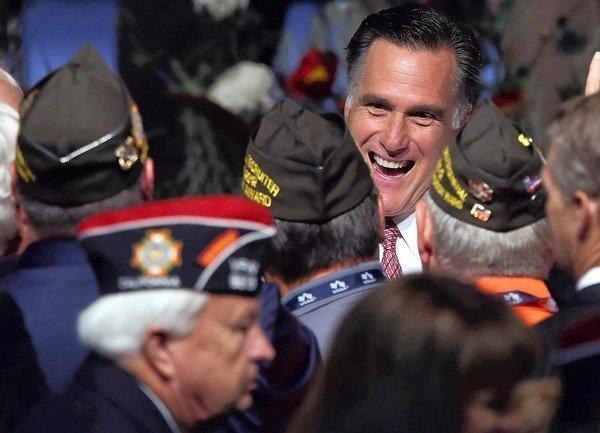
GOP presidential candidate, Mitt Romney,
with the Veterans of Foreign Wars
(Justin Sullivan, Getty)
GOP Presidential candidate Mitt Romney gave a speech to the Veterans of Foreign Wars last Tuesday (July 24th) and I guess I shouldn't be surprised that Romney got worked up over what is really very little to work with: cuts in defense spending and White House leaks regarding covert operations.

But first he started with the standard chest thumping: "I am an unapologetic believer in the greatness of America. . ."  Nope.  We cannot have a complicated perspective on the role of the US in the world.  It can't be that just maybe, our country has been a force for both good and ill.  Gotta simplify.  Recognizing complexity robs us of, well, the ability to say things like "I'm an unapologetic believer. . ."  We've got to stay as far away as we can from those terrible days of the Church hearings in the 1970s that exposed covert operations ending nascent democracies in Iran and Guatemala, attempts to assassinate Castro among others, all that crap that made us feel bad about ourselves and led to President Carter's quirky human rights emphasis, and his infamous malaise.  And we can't do the introspective thing because even as we lecture other countries on human rights and democracy we are again engaged in widespread covert operations and assassinations, though the latter we can now do with drones (never mind the civilians we take out along with the bad guys).

But this is under Obama's watch, and he has continued with many key aspects of President Bush's "war on terror" (for example, Bush-era detainment, torture, and targeted killing policies).  So what's Romney to do?  The Obama administration has shown a tough side in its foreign policy, and Romney can't do the usual Republican move of calling Democrats wimps in world affairs.  In 2004, VP Cheney warned Americans that a vote for Kerry would likely mean another 9/11. Romney didn't play such a dire fear card, but told the audience that impending cuts in defense would mean the US would no longer be the strongest nation on the earth.  A vote for Obama means, somehow, a quick slide into a second rate power, no matter that we currently outspend the next twelve countries combined on our military.  A vote for Obama means national insecurity.  It's an old, very old, and tired line.  But I suppose it works--if you can forget that these defense cuts had bipartisan support-- because it will get a rise out of those who think the response to a foreign policy challenge is, if you can't safely ignore it, then shoot it (e.g. not just an anti-illicit drug policy but a war on drugs; not just an immigration policy, but militarize the border).

The other just really awful problem with the Obama administration according to Romney is the leakage, apparently out of the White House.  Yes, like such leaks are unprecedented, as if no administration until now has tried to make political hay out of foreign policy achievements--but this is about pushing the fear button again, because, Romney asserted, by divulging aspects of covert operations, these leaks put our soldiers at risk now and in the future.  It's a "national security crisis," it's "contemptible," it "betrays our national interest."

It seems a little desperate to imply that Obama has been treasonous, but Romney had to do something to tarnish the covert op that gave Obama a boost in popularity, the assassination of Osama bin Laden.  So Romney kvetched about a high profile extra-judicial killing, not because our hands are bloodied, not because it's part of a much larger campaign of dubious legality and utility, inflicting more "collateral damage" than we care to realize, but because details of the operation got out.  It's not like I think Romney should high-five Obama for taking bin Laden out.  But it would be good to see him pull at his finely crafted hair, anxious about the murky moral landscape we're in now, or have been in for some time.  I'd like to see more of all of us do that.
Aftermath of drone strike in Buner, Pakistan, 2009
(from Council on Foreign Relations website)

I know.  It's a presidential campaign, and candidates must exude confidence rather than anxiety.  Thus Romney declared "This century must be an American Century."  It is our "destiny."  But this secular providentialism is also very old, and tired.  Why not invoke the spirit of his GOP ancestor, Lincoln, and warn against self-righteousness, announce his own version of ". . .with malice toward none, with charity for all. . ?"  But I don't expect it, not from Obama either.  Instead, we'll probably get an echo of the plaintive words of another more recent Republican president: "Why do they hate us?"


The National Review has provided a transcript of the entire speech here.


Thursday, July 19, 2012

Who Gets to be an American?

Apparently, President Obama doesn't. Arizona sheriff Joe Arpaio and other "Birthers" continue to spin conspiracy theories while more reputable figures like John Sununu say things like "I wish this President would learn how to be an American."

I thought things got strange back in the early eighties with Maranatha preachers casting out demons in the Oregon State quad and young Reaganites outnumbering liberals in the cast of Gershwin and Kaufmann's political musical "Of Thee I Sing" (a theater crowd combined with a campus setting, and you'd think there would have been more of us that thought the Reagan administration's declaration that ketchup and pickles are vegetables hilariously awful. . .).  And then there was Howard "I'm-Mad-As-Hell" Jarvis turning anti-tax hysteria into virtue, and President Reagan sunnily declaring "America is back, standing tall," to wild applause and gushing commentary, after illegally mining Nicaraguan waters and sending the troops to crush tiny Grenada.

The strangeness then doesn't compare to that of the present.  It seems the combination of economic hard times and the election of our first black president have released our inner looniness.  And while race was obviously an issue a generation ago (remember all the talk of the GOP capturing disaffected white Democrats?), it appears that Du Bois' "problem of the Twentieth Century" remains with us in the Twenty-First, though it bubbles to the surface in different ways.

Sheriff Joe Arpaio, birther extraordinaire
Matt York/AP
Now, no doubt Arpaio is in part engaged in some tit-for-tat.  He's under federal indictment for racial profiling of Latinos in his campaign against undocumented immigration.  So he once again hauls out the tired accusation that Obama is not really an American and therefore not our legitimate President.  I suppose we could see Arapio as just keeping up an old American tradition of nativism that has been around since Ben Franklin's whine back in 1751 about all those "alien" and "swarthy" Germans (I've been called many things, but I don't think "swarthy" was one of them).

But we can also consider this in the context of a broader effort to restrict the number of people entitled to be American: the anti-immigrant and so-called "self-deportation" legislation in states such as Arizona and Alabama, or new voter photo ID laws  in ten states that make it more difficult for poorer and otherwise marginalized citizens to vote, or even register to vote.  I could even mention the Obama administration's decision to justify the execution of American citizens deemed guilty of terrorism, without due process of law.

I'd say our country is in the middle of an existential morass in which we have tremendous disagreements over how we identify Americans, who gets to be an American, and what being an American really means under the law.

Former NH Governor and Romney ally, John Sununu
Denis Poroy/AP
So it's no surprise that John Sununu, instead of sticking to a critique of Obama administration policies, resorted to a complaint about the president's lack of Americanness.  As if there were one proper way to be American--a common note, but still a hypocritical one in a country that touts its pluralism.

Sununu later tried to explain what he really meant: "What I thought I said but guess I didn't say is that the president has to learn the American formula for creating business," meaning that the private sector is supposed to do it, thus adding jobs, not government.

Really?  New Deal policies that put people to work were devised by people who hadn't learned to be American?  So all those defense contractors and road construction companies in the Eisenhower era didn't do it the American way?  Absurd, and there's still the implication of Sununu's remark--if his ally Romney's policy stances are truly American, then those of us who disagree with them are what?  You guessed it, and I suppose Congress had better revive its Committee on Un-American Activities to safeguard the nation.

Sunday, June 24, 2012

Decreeing a Dream a Nightmare for Some


Beck, Qué onda guero?, Guero, 2005

President Obama's recent executive order regarding the Dream Act has predictably provoked both praise and criticism.  Let's first look at the language of the order.  In brief:
Effective immediately, certain young people who were brought to the United States through no fault of their own as young children and meet several key criteria will no longer be removed from the country or entered into removal proceedings. Those who demonstrate that they meet the criteria will be eligible to receive deferred action for a period of two years, subject to renewal.
There are five criteria:
1) Have come to the United States under the age of sixteen; 2) Have continuously resided in the United States for at least five years preceding the date of this memorandum and are present in the United States on the date of this memorandum; 3) Currently be in school, have graduated from high school, have obtained a general education development certificate, or are honorably discharged veterans of the Coast Guard or Armed Forces of the United States; 4) Have not been convicted of a felony offense, a significant misdemeanor offense, multiple misdemeanor offenses, or otherwise pose a threat to national security or public safety; 5) Not be above the age of 30.

The order, in other words, gives young undocumented immigrants temporary immunity (or "deferred action") from deportation proceedings, an immunity that can be renewed every two years.  The conservative Center for Immigration Studies (CIS) calls this "administrative amnesty," and "amnesty" among immigration hardliners is a pejorative, implying an unwarranted forgiveness of a dastardly crime.  Technically, though, this executive order does not grant amnesty at all (see legal definition of amnesty here).  There's no forgiveness, just a temporary change in status from deportable to some legal netherworld that is neither illegal or legal residency.  The order just tells prosecutors dealing with deportations that they can ignore immigrants who meet the criteria above.

Has the Obama administration "[ursurped] legislative authority," as CIS director, Mark Krikorian claims?  Hardly.  Since the New Deal era, Congress has been turning over a great deal of discretionary authority over to the executive--apparently unwilling or unable to write bills that proscribe executive action with specific language (read your Theodore Lowi. . .).  And last year a number of Senators and Representatives asked the President last year to grant deferred action on young undocumented immigrants--Democrats and Independents, yes, and one moderate Republican (Richard Lugar of Indiana, recently vanquished by the Tea Party).  Krikorian should really get on Congress' case for relinquishing authority instead of accusing President Obama of dictatorial tactics.

The presumptive GOP presidential candidate, Mitt Romney, and other Republicans have responded with what I imagine they developed as 'talking points' to blunt the impact of the order (Romney advisor, Kerry Healing delivers these points in this NPR story).

First, the executive order is merely a "stopgap measure" that does nothing to permanently fix immigration law.  This is true, but the question is whether or not the measure is a good policy move or not given Congress' inability to move on immigration reform, including the Dream Act.  I happen to think it is, for practical and idealistic reasons.  The Migration Policy Institute (MPI) estimates that this order could affect the status of around 1.4 million people, and focusing constrained resources on deportation efforts against immigrants with criminal records makes sense.  And to treat immigrants who came before the age of seventeen, before the age of consent, also makes sense since it jives with our tradition of limiting the legal culpability of children.  And I agree with the American Immigration Council's response:
The administration has acted responsibly and compassionately to a growing humanitarian crisis--thousands of undocumented young people, whose talents and energy are incredibly valuable to this country, languish while Congress refuses to act on the DREAM Act.
As well, this policy initiative makes more economic sense than the harsh and costly laws in Arizona, Georgia, and Alabama that promote what is euphemistically called 'self-deportation' (see Your State Can't Afford It).  Don't we want these hundreds of thousands in the legal workforce, getting degrees, joining the military?

Mothers arrive to pick up their children from Flowers School in Montgomery, Ala., Friday, Sept. 30, 2011. Hispanic students have started vanishing from Alabama public schools in the wake of a court ruling that upheld the state's tough new law cracking down on illegal immigration. (AP Photo/Dave Martin)

Second, Obama doesn't really care about Latino/as or about immigration law as much as he pretends; otherwise he would have accomplished reform when he Democratic majorities in both chambers over 2009-10.  This is just plain wrong.  The House did pass the Dream Act in 2010 (after a failed attempt in 2009), but the now standard GOP filibuster  in the Senate killed it (five Democratic Senators helped with that).

And third, it was pure politics, on two levels, one as an election year gimmick and the other to undercut Senator Mark Rubio's intention to introduce his own version of the Dream Act (Rubio may be on Romney's list of possible Vice-Presidential candidates). For sure, there were political motivations in this election year, but the Republicans can hardly complain too loudly since so many of them have been ambivalent or even hostile to comprehensive immigration reform, as well as the Dream Act. And it's not just politics--since the death of the Dream Act in 2011 there has been a growing chorus of members of Congress and immigrant advocacy groups calling for just such a move.  Obama's proclamation hardly appeared in vacuum.  As for Rubio, what's to stop him from pushing his own version of the Dream Act? Moreover, Obama's order may well provoke Congress into action on his legislative proposal.

GOP and other critics, rather than complaining about motivations, should be talking about something far more important--does the federal government have the capacity to implement this directive?  The executive order mandates a case-by-case review of applications and--as the MPI points out--with the policy taking effect in two months, there's a lot of work to be done training staff, outreach, and resolving questions of what counts as evidence to support the criteria (such as proof of entering before sixteen).  Given the huge backlogs on other immigrant issues--cases in Los Angeles immigration courts sit for almost two years on average before being resolved--I have my doubts the Dream decree will be ready to go in August.

Sunday, May 6, 2012

PDA Police?


Sodahead
I remember an older calculus teacher in high school, we're talking 1975-78, who would run up behind kids holding hands and and separate their hands--I saw him do it once with a sort of soft karate chop.  The same teacher would say "Put away the dirty books" when he caught a student reading something unrelated to the class (not me, ever; I was too busy playing Battleship).


I suspect the poor guy had some issues, and maybe he would have been happier were he teaching today in Tennessee.  The Tennessee state legislature just passed a law mandating abstinence-only sex education in its public schools, what the law calls "family life curriculum."  This mandate applies only to those schools (what Tennessee calls "Local Education Agencies," or LEAs) in counties where the pregnancy rate among 11-18-year olds is over 19.5 per thousand.  Given that the birthrate among 15-19 year-olds (the rate is drastically lower among those <15, thank god) ranges from 32 to 98 among 94 of the 95 counties, almost every LEA is likely under the mandate. The exception are those in Williamson County, a white, wealthy suburb of Nashville, where the rate is a remarkable 14 (2012 data available here).


What's stirring the most controversy in this law is the notion of a "gateway to sexual activity."  The law defines it as
sexual contact encouraging an individual to engage in a non-abstinent behavior. A person promotes a gateway sexual activity by encouraging, advocating, urging or condoning gateway sexual activities (Sec. 2, 49-6-1301, pt. 7)
The law then states that the
instructor of the family life curriculum shall not. . .Promote, implicitly or explicitly, any gateway sexual activity or health message that encourages students to experiment with non-coital sexual activity (Sec. 2, 49-6-1304, pt. c.1)
The law then gives parents and legal guardians the right to formally complain about teachers or other kinds of instructors who they think are not complying with the law, and it's up to local school boards to adjudicate those complaints (Sec. 2, 49-6-1306, pt. a).  Moreover, they can sue those temporarily contracted instructors or organizations they believe are promoting "gateway sexual activity."
If a student receives instruction by an instructor or organization promotes [sic] gateway sexual activity or demonstrates sexual activity, as prohibited under this part, then the parent or legal guardian shall have a cause of action against that instructor or organization for actual damages plus reasonable attorney's fees and court costs; provided, however, this subdivision (b)(1) shall not apply to instruction by teachers employed by the LEA.
The subtext here is Planned Parenthood.  A main proponent of this legislation, the Family Action Council of Tennessee (FACT), makes this clear in its FAQ sheet on the bill.  It doesn't want Planned Parenthood to have anything to do with sex education because its "approach to teens about sex is simple: anything goes, just don’t contract a sexually transmitted disease (STD) and use 
condoms if you don’t want to get pregnant."


That characterization isn't completely off base. Planned Parenthood's information on "Outercourse" is sexually explicit, though of course its message is much more complicated, and I would argue that Planned Parenthood's goals are the same as those opposed to any sort of sexual contact prior to (heterosexual) marriage: the safety and emotional security and happiness of young people.  They just radically differ over the means.  Planned Parenthood's approach rests on the assumption that the vast majority of adolescents are going to engage in some sort of sexual experimentation no matter what kind of local rules are in place; the other, like FACT, presumes that enforced norms of sexual abstinence can work.


As FACT complains, though, the law has been unfairly framed in terms of a loose understanding of "gateway to sexual activity." For example, one Tennessee legislative opponent said, "Gateway sexual activity is so vaguely defined it could be holding hands, hugging, anything that teenagers do like that." This may have been the sound bite provoking parodies like that of Stephen Colbert, who after listing a variety of ways teens sexually distract one another, said
You know what really leads to leading to sex?  Eye contact.  That's what it is. And because the subtlest glance could lead to sexual activity, that is why I believe every child should be fitted with a pair of horse blinders. . .
 Wait, Wait, Don't Tell Me's Peter Sagal joked that the law "prompt[ed] many students in Tennessee to ask ‘Where is this gateway and how soon can we get there?’"  He then offered this suggestion: 

Peter Sagal: Exactly. We were thinking about this, and we, we have a message for the people of Tennessee. If you want to encourage abstinence. . .in your students. . .this is what you do. You mandate explicit education, but you also mandate that it be taught to the students by their parents, okay?
Kyrie O’Conner: Ewwww.
Peter Sagal: One thing I’ll say about your Mom, son, she is a wildcat.
Roy Blount, Jr.: Awww, no!

Even some ostensibly neutral journalists framed the law this way.  A Tennessee TV news station topped its story "Teen birth rates drop, but Tennessee is still in top 10" with the image below, implying that the distance between the kiss and pregnancy is pretty short.


But as the bill's sponsor pointed out, the law does clearly identify "gateway" as "sexual contact," which in Tennessee law is already defined as the "intentional touching" of intimate parts "for the purpose of sexual arousal or gratification."  The problem with this is that the "sexual contact" the sponsor references is in criminal law (e.g. rape, incest).  In fact, there's a vague air of criminality in another section of the new bill that jives with goal of making teachers police their students' sexual conduct.


The bill links sexual activity to other illicit or criminal behaviors, and mandates that sex education teachers 
Discuss the interrelationship between teen sexual activity and exposure to other risk behaviors such as smoking, underage drinking, drug use, criminal activity, dating violence, and sexual aggression (Sec. 2, 49-6-1304, pt. 9)
I guess I shouldn't be too surprised.  We've long associated with sex with bad, wrong, and meriting punishment.  Our equation of sexual desire with guilt comes out in teen slasher movies that routinely destroy the sexually active kids in whatever group happening to wander into horror's way (Joss Whedon and Drew Gordon deliciously subvert this trope in the recent film Cabin in the Woods).  Still, I don't get it.  A high school guy making second base will end up sucking on a beer bong (and third base inevitably leads to snorting some lines)?  The girl smoking a J is at greater risk of pregnancy (and probably an abortion since she's obviously an immoral lout)?


I agree that high teen pregnancy rates are more than lamentable.  They too often mean tragedy for both the mother and the child.  But I doubt trumpeting another 'Just Say No' type of campaign will work (or, just say nothing--which Utah has begun with legislation prohibiting schools from teaching anything about contraceptives or homosexuality, and permitting schools to opt out of any sex education).  Churches and schools that repeat "no to sex" to teens only remind them of the topic of sex, just as much as a comprehensive sex ed program.  On top of that, teens are surrounded by public figures--politicians, religious leaders, athletes, celebrities, and teachers--who repeatedly demonstrate an inability to restrain their sexual desire.  And there are all the shows and advertisements that equate sexual desire (or fulfillment) with material consumption and personal satisfaction (you'd think a new car is one of Woody Allen's orgasmatrons), there's the prurient fascination with sex crimes in the media, not to mention the accessibility of internet porn.


I'm not arguing that abstinence-only folks are fighting a losing battle, and that therefore they should give in to the inevitable.  I'm saying they're fighting the wrong battle.  Teaching sex education to teens by trying to turn them into ascetic monks and nuns, resisting "evil" urges until they can doff their chastity in marriage, is not just impractical.  It replaces the simplistic biological determinism (kids are meant to march through that "gateway," no matter what) with an equally simplistic behavioral determinism (training and punishment will stop up that "gateway").  It turns an ubiquitous feature of the adolescent world into a toxic characteristic (if Friday the 13th's Jason puts an ax into your adolescent head just after you had sex, well, maybe your poisonous self deserved it).


That said, of course there are people who have been hurt or damaged by sexual activity at a young age.  But continuing to try to invent different ways to excise sexual activity among youth isn't the way to reduce that hurt and damage, or teen pregnancy rates.


Consider two relevant findings by the Guttmacher Institute (a think tank focused on sexual and reproductive health):
 •Strong evidence suggests that comprehensive approaches to sex education help young people both to withstand the pressures to have sex too soon and to have healthy, responsible and mutually protective relationships when they do become sexually active. 
•There is no evidence to date that abstinence-only-until-marriage education delays teen sexual activity. Moreover, research shows that abstinence-only strategies may deter contraceptive use among sexually active teens, increasing their risk of unintended pregnancy and STIs.
Sex is an incredibly complicated matter, not just because we're still not sure of all the factors that drive sexual behavior (the nature vs. nurture thing), but because our identities, our emotional security, and our moral universes are so tightly connected to the topic.  While the Tennessee bill doesn't turn teachers into PDA police, it does turn schools into agencies of a sex education policy that has a dubious track record, an overly dark view of human sexuality, and makes up for both by trying to silence contrary voices with the threat of lawsuits and fines.