Showing posts with label US Foreign Policy. Show all posts

Sunday, February 8, 2015

Book Review: Sword of the Spirit, Shield of Faith.


Sword of the Spirit, Shield of Faith is an excellent survey of the history of "religion in American war and diplomacy," though I'm not sure why he says "religion" when he really means Christianity, the principle focus of this work.

The title is drawn from Ephesians, chapter 6, where Paul instructs believers to put on the "armor of God." Preston uses this to sum up his argument that Christianity has placed two distinctive, even contradictory, pressures on US foreign relations.  "Sword of the spirit" refers to the one current of Christians who believe in American exceptionalism and that their country, in both peace and war, can or does serve a providential role.  "Shield of faith" is a contrary current, one in which we find Christians taking pacifist or anti-interventionist stances.  Not sure the biblical reference really matches this current--no doubt the exceptionalists (like Romney and Ryan in the 2012 presidential campaign, or Bush before them) think their position is about lifting up that "shield of faith" as well as the "sword of the spirit."  Might be more appropriate to reference one of the jeremiads in the Old Testament (like one of those of my favorite prophet, Amos), or Jesus advising people to take the log out of their own eyes before trying to remove the speck from someone else's.  But it's hard to turn either of those into snappy titles, and anyway, it's silly of me to get snippy about a title.

Preston's history moves back and forth between three levels--cultural, organizational, and individual.  That is, he describes Christianity's impact on foreign relations works via ideas, religious pressure groups, and prominent religious and political leaders.  This broad approach probably wouldn't satisfy those political scientists looking to locate and weigh the explanatory weight of this or that factor.  But Preston is not out to make an argument about causation.  Rather, he wants to give us enough evidence to make his thesis believable--that we can't fully comprehend US foreign relations without some reference to religion.

I think he makes a pretty convincing case (though since I already agreed with the thesis, I may be biased). However, I don't agree that "religion has had an almost uniquely intimate relationship with American war and diplomacy."  After all, religion played prominent roles in the Roman, Spanish, and British empires and other imperial ventures (for example, state-sponsored Shintoism accompanied the Japanese bid for regional hegemony in the 1930s and 40s in East Asia).  But that's about the only time that Preston seems to share the exceptionalism he examines.  The book on the whole neither trumpets Christianity's impact on US foreign relations, nor criticizes it, though, as he says at the outset, "Readers will of course use the material in this book to support their own beliefs that religion is either a productive or pernicious force in American foreign relations."  Thus 19th century US missionaries were both agents of informal empire-building and also brought the outside world back to their parishes, putting at least a small dent in the parochial character of many Americans.  But, really, the bulk of Preston's evidence is about the collaboration of many Christians with US interventionism and war-making.  Those with a "shield of faith" sensibility will wonder why their side lost out repeatedly, from the colonial massacres of Native Americans and conquest of a huge chunk of Mexican territory in the latter 1840s to the Vietnam war and our most recent bloody follies in Afghanistan and Iraq.

One of Preston's more significant arguments is his chapter on the early Cold War period, which he titles "The Great Schism and the Myth of Consensus."  There he criticizes what he says is the common depiction of the years after WW II--a homogenous religious landscape.  He reminds us that there was a great deal of debate among Christians about whether and how the US should conduct its Cold War with the Soviets. I was surprised and fascinated to learn that even the president of the Southern Baptist Convention in 1946 thought the USSR had potential for good, and that Catholic groups refused to participate in air-raid drills.

The rest of the history is a recounting of the growing diversity of religious affiliations in the US, the schisms within mainline Christian denominations, yet their ongoing impact on US foreign policy via their mission activities, not to mention the importance of the Vatican II reforms and the later resurgence of Christian fundamentalism, particularly important to Reaganism in the 1980s. He wraps up the post-Reagan history quickly, perhaps too quickly, in an epilogue titled "The Last Crusade?" George W. Bush's administration gets about two pages. It deserved a bit more. This is a period, to my mind, that shows the declining purchase of conservative Christianity on US foreign policy. I know this sounds counter-intuitive, but despite Bush's efforts (and those of his allies) to compare himself to Truman, and infuse the "Global War on Terror" with the religious sensibility evident in the early Cold War, he failed. The subdued narrative of US's providential mission in Afghanistan and Iraq never achieved purchase among the majority of Americans.  Yet Preston ends with a deft description and analysis of President Obama's religiosity, and its roots in Reinhold Niebuhr's "Protestant realism." It's a position that doesn't mollify the Left and its relativistic predisposition, nor the Right, and its pining for an exceptional, sinless America that does the Lord's work in the world.

In short, Preston has done us a service with this book. A complicated, rich history of the relationship between an ever-shifting religious tableau in the US, and its dealings with the world.


Tuesday, May 14, 2013

A Limber State, a Wounded Body Politic

Blog Song for the Moment

Hans Zimmer, Time, from Inception (2010)

Some Republicans have been trying and trying to Watergate President Obama with the Benghazi Affair (though they may be really aiming at Hilary Clinton), but the administration has just handed them something even better--a real scandal.  Actually two.

One is the revelation that the IRS has been targeting some conservative organizations, giving their requests for tax-exempt status as non-profits extra scrutiny, such as requesting the identity of their contributors.  In response to complaints from constituents , GOP lawmakers questioned IRS commissioners last year, who replied that the IRS did have the authority to request donor information.  Though they didn't mention targeting, at least one commissioner knew about it as early as May 2012. As reported in Politico:

Lois Lerner, the head of the IRS division the oversees tax exempt groups, acknowledged that groups seeking nonprofit status were flagged for additional review if their applications included phrases like “tea party” or “patriot.” She told reporters that requests for donor information isn’t standard practice at the IRS.
On top of this, we have the DOJ seizing private records from AP reporters and wire services.  According to the AP
The Justice Department secretly obtained two months of telephone records of reporters and editors for The Associated Press in what the news cooperative's top executive called a "massive and unprecedented intrusion" into how news organizations gather the news.
Apparently the DOJ was after the source of a leak that it deemed a threat to national security, that is, a leak about a proposed operation in what ever we're calling the "War on Terror" these days.  But what a stupid, heavy-handed way of going about it.

So, along with the IRS handing Tea Party groups their "biggest victory yet," as Slate's David Weigel suggests, the DOJ has given the GOP one more reason--a good one this time--to investigate the hell out of the Obama administration, gumming up government operations, along with distracting Congress from crucial matters that need its attention--say, immigration reform for starters.

Administration officials are to blame, and I imagine some heads will roll, but I think their are also some systemic problems behind these humongous gaffes.  The role of big money in campaigns, combined with political polarization, created an environment encouraging what was likely illegal behavior in the IRS.  As for the DOJ--it's serving the needs of an executive trying to combat terrorism with means that violate domestic and international norms and laws.

Writing during WW I, Randolph Bourne pointed out the paradox for democratic regimes waging war.
Democratic control of foreign policy is therefore a contradiction in terms. Open discussion destroys swiftness and certainty of action.  The State is paralyzed. . .(from "War is the Health of the State")
Bourne was talking about growing restrictions on civil liberties as the Wilson administration geared up for war in Europe.  Today it's the Obama administration, like the previous one under Bush, working mightily to avoid this paralysis.  They have succeeded so far in keeping the State limber, but at the cost of wounding our democratic body politic.

Tuesday, September 18, 2012

Back-burner or Big Stick: The Demos and GOP on Relations with Latin America

Neither Democrats or Republicans have much worthwhile to say about Latin America. Both  party platforms depict the region as little more than a source of insecurity for the United States. Democrats offer vague promises to continue the war on drugs and organized crime while Republicans clamor for a return to a Reagan-era aggressive stance that treats the region as our private backyard.  Both reveal the condescension most Americans have long applied to the region, when they've bothered to think about it at all.

Here's what the Demos have to say:
In the Americas, we have deepened our economic and security ties with countries throughout the hemisphere, from Canada and Mexico to Brazil and Chile and El Salvador. We have strengthened cooperation with Mexico, Colombia, and throughout Central America to combat narco- traffickers and criminal gangs that threaten their citizens and ours. We will also work to disrupt organized crime networks seeking to use the Caribbean to smuggle drugs into our country. As we collectively confront these challenges, we will continue to support the region's security forces, border security, and police with the equipment, training, and technologies they need to keep their communities safe. We will improve coordination and share more information so that those who traffic in drugs and in human beings have fewer places to hide. And we will continue to put unprecedented pressure on cartel finances, including in the United States.
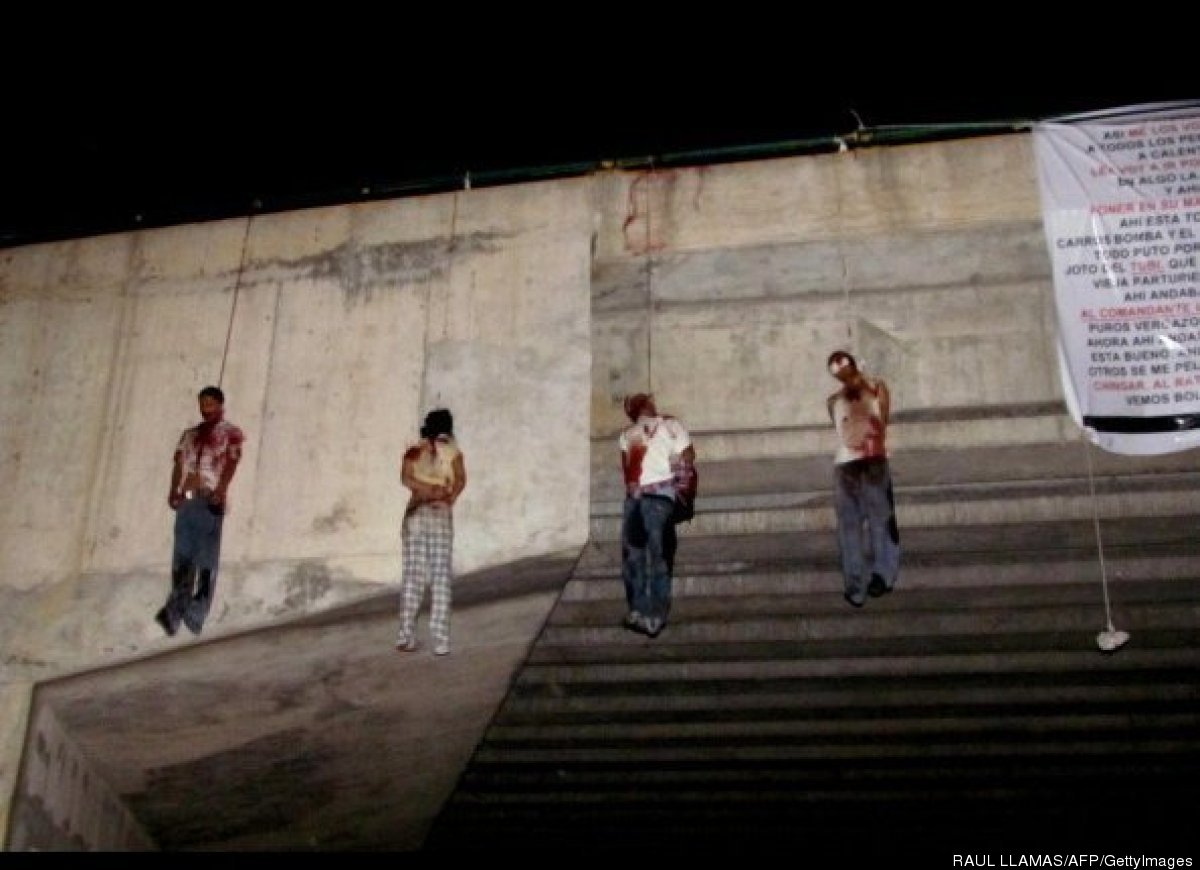
What's the implicit message of this plank? The whole region is a morass of criminality and violence, a conduit of threats to the United States.  Of course there has been a horrendous stream of violence flowing out of the drug trade, but it is hardly the case that Latin America is entirely awash in it. To reduce the region to this characterization is unjust, misleading, and distracts us from other important ways Latin American countries figure in US interests and opportunities, and the way the US figures into theirs.  There is a passing reference elsewhere in the section on foreign policy to increasing the number of free trade agreements in the region, along with improving commercial airline accords.  But, at least for this campaign, Democrats have nothing to say about strengthening geopolitical alliances, working together to resolve collective problems like global warming, assessing the growing global weight of Brazil (forging stronger ties with China, India, and Russia, in a loose economic association known as BRIC), nor considering the implications of the rise of CELAC (Community of Latin American and Caribbean States), an alternative to the Organization of American States that excludes the US, as well as Canada.
Is this all Latin America is?
Atrocities in Mexico's Drug War
Maybe Latin America is also this?
At a political rally in Guatemala City's Plaza Central, 2011
where we, surprisingly, dodged no bullets, nor stumbled over cadavers.
I realize these issues don't inspire a lot of interest in voters, most who are oblivious to Latin America, apart from those who can afford the tourist destinations.  Still, there could have been at least an echo of President Obama's speech at the OAS's 2009 Summit of the Americas:
All of us must now renew the common stake that we have in one another. I know that promises of partnership have gone unfulfilled in the past, and that trust has to be earned over time. While the United States has done much to promote peace and prosperity in the hemisphere, we have at times been disengaged, and at times we sought to dictate our terms. But I pledge to you that we seek an equal partnership.
Instead, we get a caricature of US-Latin American relations. And if the numbers of words devoted to the region in comparison to those of others matters, clearly, Latin America is on the back-burner in the Democratic Party's mind.

The Republicans note this too, though in stronger terms: "The current Administration has turned its back on Latin America."  While overstated, it has a grain of truth.  Unfortunately, the Republicans turn this grain into statements revealing that the GOP has stepped into a time warp, trapping them in Cold War frame-of-mind, if not earlier, say, the Roosevelt Corollary of 1904, by which the US government claimed the right to intervene in the internal affairs of Latin American countries if it thought it in their best interest.

The Republicans started their section on "Strengthening Ties in the Americas" with this imbecilic line:
We will resist foreign influence in our hemisphere. We thereby seek not only to provide for our own security, but also to create a climate for democracy and self-determination throughout the Americas.
What is this "foreign influence?" Ever in need of enemies to fight and generate fear for their constituency, Republicans make the hysterical claim that "Venezuela has become a narco-terrorist state, turning it into an Iranian outpost in the Western hemisphere."  Even The National Interest, a journal featuring conservative scholars and pundits, thinks the threat of Chavez overblown (interestingly, the  libertarian think-tank, The Cato Institute, reposted this article). Who actually has the most "foreign influence" over Latin America?  The United States--by far the largest trade partner for most Latin American countries, the predominant source of arms imports, with a military presence in Mexico, Central America, the Caribbean, and Colombia.  Maybe the Vatican places a very distant second given the prevalence of Catholicism in the region, and the always wildly popular visits by the pope.
Scary "foreign influence?"
Gringo Spring Breakers in Cancún.
See one of my favorite Onion videos here:
"Mexico Builds Wall to Keep Out US Assholes"
More scary "foreign influence?'
Pope Benedict's recent visit to Cuba.
And the "create a climate. . ." line?  As if there hasn't already been a surge of democratization since the early 1980s throughout the region, in spite of US support of authoritarian regimes through the 1960s and 1970s?  As if it was the sole responsibility of the US to create this climate--and had the capacity to create it? (Oh, what a climate we created in Afghanistan and Iraq)  The historical blindness and hubris this line requires are breathtaking.


At least the GOP has a few specific proposals, namely continue the US embargo on Cuba. In place since 1962, it has done just a terrific job over the last fifty years in hastening the end of the communist regime (NY Times).  Though imposed by Democratic administration, Republicans would have us lumber along with policy that has only caused the Castro government to hunker down. Similarly, George W. Bush's support of the military coup that briefly ousted Hugo Chavez back in 2002 only assured another anti-American regime in the region. Given the tone of this platform's foreign policy stance, a Romney administration will feature a return of Reagan-era cold warriors or their acolytes, carrying Teddy Roosevelt's "big stick,"and not even bothering to "walk softly."

It is unfortunate, but not surprising, that neither party platform in their statements about the "war on drugs" connects narco-trafficking to the huge maw of demand here in the United States (UN 2012 World Drug Report).  Nor do they recognize ways that US foreign policies might contribute to conditions encouraging migration.  For example, in the 1980s, US support of military regimes in El Salvador and Guatemala, and of anti-Sandinista guerrillas in Nicaragua (the "Contras"), produced a stream of refugees, many of whom ended up in the US, establishing a migration network that facilitated even more legal and illegal migration in the 1990s and 2000s (Migration Information, see also Migration Policy Institute 2011 Report).  Likewise, while NAFTA in the long run was supposed to contribute to economic growth in Mexico, and thus multiply economic opportunities. But in the short-run, it displaced small and medium agricultural producers who couldn't compete with US producers, thus creating a large swath of people the Mexican job market could not accommodate.  Hence one reason (not the only one, of course) for the spike in illegal migration to the US (Council on Hemispheric Affairs).

I can't expect party platforms to exhibit too much complexity, but I do wish that both Democrats and Republicans would work to cure the myopia that distorts our vision of US-Latin American relations.  Misconceived and unjustified characterizations of Latin America in both party platforms misinform voters, and contribute to unhelpful stereotypes of Latin Americans.  This makes it easier to cast all the blame for illicit drugs and illegal immigration on our neighbors to the south, which in turn makes it harder to have a thoughtful, useful debate about US-Latin American relations.  Silly me, though, for wanting something like that in a presidential campaign.

A parting comment.  I glanced at opinion polls in five Latin American countries about the 2008 presidential candidates, and then Obama's 2010 favorability ratings in five Latin American countries.  Some really interesting, and surprising variation. I would have thought Obama would have fared better in Venezuela than Colombia, and be more polarized in Colombia--but the opposite is true.  And given the high level of ambivalence in 2008, for whatever reason, Obama's popularity has climbed the most in Colombia.  But, as I suspected, Obama gets higher unfavorable ratings in Guatemala and Mexico, where news of the ramped up raids and deportations of undocumented immigrants from these countries has been widely reported.


Winner of US presidential elections that is more desirable for Latin America?

Argentina
Brazil
Colombia
Guatemala
Mexico
Venezuela
Obama
49.0
53.1
32.1
26.6
36.7
37.6
McCain
4.6
13.0
8.5
13.5
13.7
11.8
Same
46.4
33.9
59.3
59.9
49.6
50.6


Opinion in favor of foreign leaders: Barack Obama, 2010
Very Favorable
12.5
19.6
21.2
13.0
10.6
13.5
Fairly Favorable
61.8
67.5
64.8
55.4
55.3
47.0
Fairly Unfavorable
19.2
9.7
9.4
22.2
18.5
21.6
Very Unfavorable
6.5
3.2
4.5
9.4
15.5
17.9